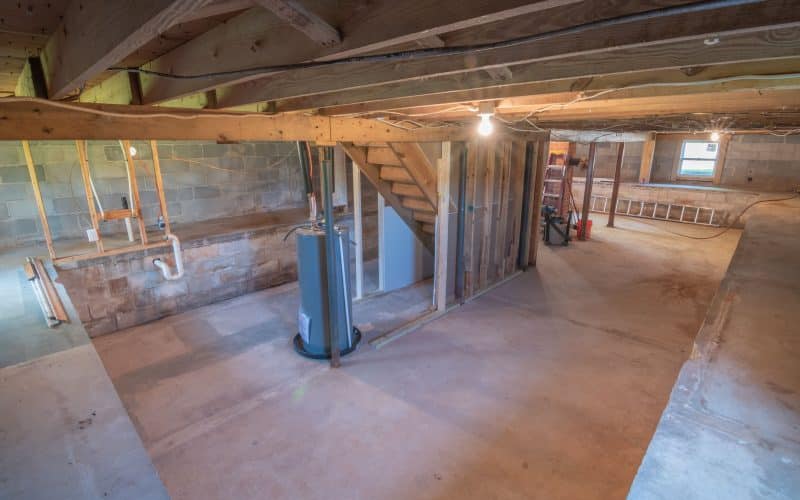





Home renovation projects rarely go exactly as planned. According to the 2026 Houzz and Home Study, 37% of homeowners exceeded their budget in 2025, and 34% turned to credit cards to help cover the costs.
Angi currently estimates an average in-ground pool installation costs around $65,909, but could run to over $87,000. Mariel Loveland at Angi warns homeowners to “budget for excavation, permits, fencing and decking […] as these expenses add up quickly beyond the installation.”
For those reasons, a pool project is certainly vulnerable to overrun. So for a five-figure renovation like this, testing financing scenarios before committing helps you establish what different loan amounts, rates and terms would mean for your monthly budget.
What Makes the Best Pool Loan Calculator for Estimating Monthly Payments?
A pool loan calculator estimates a monthly payment from three primary inputs — amount borrowed, interest rate and repayment term.
The most useful calculator lets you adjust the variables that determine your payment and easily compare several scenarios. Here are the features to look for in the best pool loan calculator:
|
Feature |
Why it matters |
How to Test It |
|---|---|---|
|
Adjustable loan amount |
Tests different project budgets |
Calculator should let you input any loan amount |
|
Adjustable loan terms |
Payment across 10 years or 20 years differs vastly |
Look for a term selector with at least 3 options |
|
Manual interest rate entry |
Shows how rate changes affect payments |
Calculator should let you input any rate |
|
Clear monthly estimate |
Makes scenarios easy to compare |
Calculator should easily display the monthly figure |
|
No email required |
Free estimation without sales pressure |
Calculator loads without registration |
Lyon Financial, a specialist swimming pool facilitator that has been helping homeowners build dream pools since 1979, advises that “Transforming your backyard starts with a firm understanding of your budget. A pool payment calculator will give you an instant estimate of your monthly payments, so you can realistically explore financing options that fit your plans.”
How Do You Use a Pool Loan Calculator to Estimate Accurate Payments?
Running scenarios through a calculator takes just minutes when you follow a straightforward process.
- Start with a realistic estimate: calculate the amount that actually needs financing, not a rough guess.
- Enter a plausible interest rate: Test alternatives rather than assuming one rate will apply to your situation.
- Compare several repayment periods: Monthly payments change dramatically across different terms.
- Record the resulting monthly payments: Write down each scenario so you can compare them side by side.
- Remember that calculator results are estimates: These figures help with planning, but are not credit offers.
How Can Using a Pool Loan Calculator Save You Money?
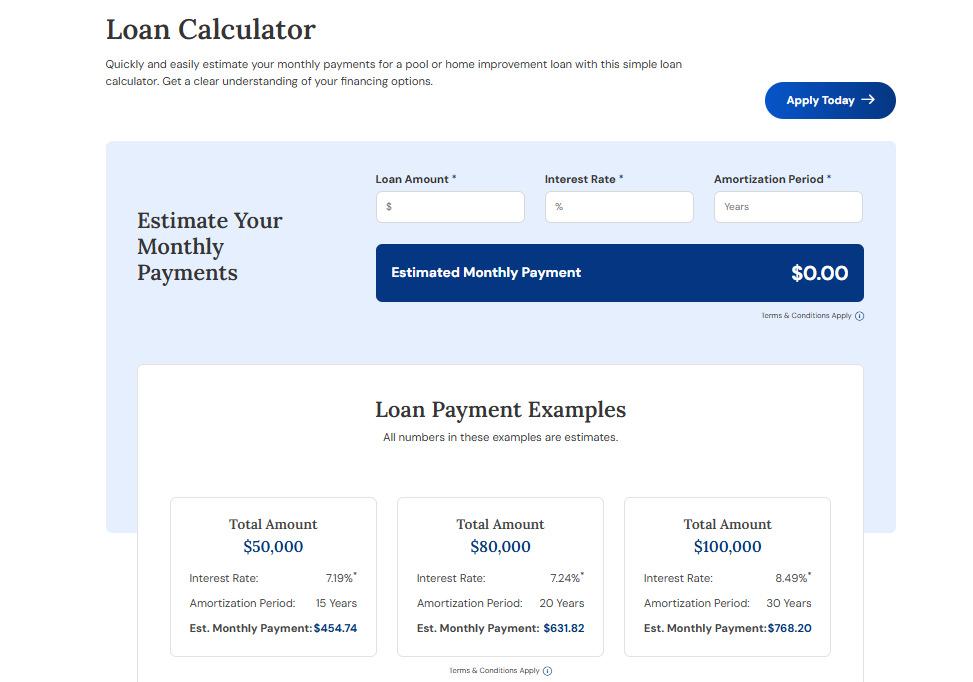
Running numbers through a calculator exposes how small changes in interest rates or repayment terms can drastically alter what you pay each month. Seeing the difference a half-point APR can make might prompt you to shop around for a better rate rather than accepting the first offer.
Understanding how much of a difference 10 years versus 20 years makes can inform smarter decisions about which financing structure works best for your household budget.
What Steps Should You Follow When Comparing Pool Loan Payments?
Whether your loan is for a car, a pool or a vacation, assessing different loans follows the same process. The Consumer Financial Protection Bureau notes that “it’s common to focus on the monthly payment, but there are other factors that have more impact on the total costs you’ll pay over the life of your loan.” It goes on to emphasize that the APR, term length and total amount will all impact how much you eventually pay.
Follow this four-step calculator test when comparing options.
- Set your borrowing range. Test realistic project amounts rather than only the ideal budget.
- Test different rates. See how rate changes affect monthly affordability.
- Compare repayment terms. A longer term can reduce monthly payments, but can increase total borrowing cost.
- Compare the whole loan, not just the monthly number. Consider APR/rate, term and total cost before selecting financing.
How Much Could Different Pool Loans Cost Per Month?
The table below uses Lyon Financial’s published examples at the time of writing. These are not guaranteed rates or offers, and actual terms and payment depend on the financing offered to an individual borrower.
|
Loan amount |
Example rate |
Term |
Estimated monthly payment |
|---|---|---|---|
|
$50,000 |
7.24% |
15 years |
$456.15 |
|
$80,000 |
7.24% |
20 years |
$631.82 |
|
$100,000 |
8.49% |
30 years |
$768.20 |
The type of loan also impacts your monthly payment. Fixed-rate loans lock in a single interest rate for the entire repayment period, while variable-rate loans can fluctuate with market conditions. Lyon Financial notes that “a fixed pool loan rate removes guesswork by keeping your interest rate steady for the entire term — whether you finance your pool for 3 years or 30.”
What Is Principal vs. Interest?
Principal is the amount borrowed, while interest is the cost charged for borrowing it.
So, using an example scenario, a $50,000 loan at 7.24% over 15 years results in a $456.15 monthly payment. Over 180 months, you would pay roughly $82,107 total. That means you borrowed $50,000 in principal and paid approximately $32,107 in interest.
Why Should You Compare Total Pool Loan Cost, Not Just Monthly Payments?
A longer repayment period generally reduces the monthly payment, which makes financing feel more affordable in the short term. However, it also means paying interest for a longer stretch. That’s why the smallest monthly payment is not automatically the cheapest borrowing option. Compare the loan amount, interest rate, term and monthly payment together to understand the full picture.
Why Calculate Pool Financing Before Finalizing Your Project Budget?
With so many people exceeding their budgets and pool builds or renovations costing five figures, homeowners need to understand both their project budget and borrowing capacity before signing any contracts.
Even after you have used a pool financing calculator and feel confident about your affordable range, scrutinize the small print in any offer. Check whether the rate is fixed or variable, confirm the full term length and verify whether any fees apply at closing or throughout the repayment period.
How Should You Finance Your Pool Once You Have Calculated Your Budget?
Several financing options exist depending on your financial situation and priorities.
- Cash-out refinance: Replace your current mortgage with a larger one and use the difference to fund your pool project.
- Home equity line of credit: Borrow against equity in your home with a revolving credit line.
- Unsecured personal loan: Borrow without collateral based on your creditworthiness and income.
Using equity carries a risk since you are putting your home on the line if financial circumstances change. Lyon Financial, which specializes in pool financing with no equity required, observes that “many families prefer unsecured pool financing that keeps payments stable and preserves equity.”
Frequently Asked Questions
These quick answers address the most common questions about pool loan calculators.
How can you calculate your monthly payment for a new pool?
Enter the amount you expect to borrow, the estimated interest rate and the loan term into a pool loan calculator. Test multiple rates and terms because the first scenario is only one possibility. Treat results as planning estimates until an actual lender provides terms.
What will your payments be for a $50,000 pool loan?
Your payments will depend on the interest rate and payment terms. As an illustrative example, $50,000 at 7.24% over 15 years equals $456.15 per month.
How do interest rates affect your total pool loan cost?
Higher interest rates generally increase borrowing costs. Monthly payment also depends on loan amount and term, so compare the same loan amount across several rate and term scenarios. Selecting financing purely by the lowest monthly figure can mislead you about the total cost.
Calculate First, Build Confidently
The most useful pool loan calculator is one that lets homeowners easily change loan amount, rate and term and compare realistic scenarios. Using a calculator can save your money over the long term, because it will highlight which loans within your budget offer the best long-term value.